Friday, 14 June 2013

FIRLE PLACE, EAST SUSSEX, ENGLAND

 Firle Place has been the home of the Gage family since the fifteenth century.  Sir John Gage (1479-1556), who built the original Tudor house in 1473, was descended from a Norman Baron who arrived with William I at the Battle of Hastings in 1066.


Sir John Gage held various posts in the court of Henry VIII, including Vice-Chamberlain, Knight of the Garter and Constable of the Tower of London.  He was in charge of the Tower of London when the future Queen Elizabeth I was imprisoned there.


Sir John Gage was a Catholic, and his family was barred from advancement after Henry VIII became head of the independent Church of England.  However his descendent, Sir William Gage (1695-1744) joined the Church of England in 1730.  He set about enhancing Firle Place, by building two long galleries and an external facing of Caen Stone  around the property.


Other well-known members of the Gage family included George Gage, (1572-1638), who was chosen to negotiate on behalf of James I to obtain a papal dispensation to enable his son, Prince Charles, to marry the Infanta of Spain.


 Sir Thomas Gage (1719-1787), joined the armed services and went to America, where he became commander in chief of the British forces.  He was a contemporary of George Washington.  

His actions in America are said to have contributed to the start of the American War of Independence.  He was defeated in a famous battle at Bunker Hill.  Portraits of him wearing the 'red coat' of the British forces hang on the walls of Firle Place.


In the 19th century, another Sir Thomas Gage (1781-1820) is credited with creating the name of the greengage plum. Sir Thomas was a horticulturalist who imported plum trees from Chartreuse, where his brother was a Roman Catholic priest.  The labels for the trees were apparently lost in transit, and the plums became known as greengages after Sir Thomas.

The Gage family continue to live in Firle Place, and the house reopened to the public in 2013, after restoration work.

Village of Firle


'Firle refers to an old-English/Anglo-Saxon word fierol meaning overgrown with oak...During the reign of Edward the Confessor (1042–66) Firle was part of the Abbey of Wilton's estate. 


Following the Norman conquest of England the village and surrounding lands were passed to Robert, Count of Mortain. Half-brother of King William I, Robert was the largest landowner in the country after the monarch. 


The village is mentioned in the Domesday Book, referred to as 'Ferla'. The value of the village is listed as being £44, which was amongst the highest values in the county.

The manor house, the site on which Firle Place now stands, was occupied from the early fourteenth century by the 'de Livet' (Levett) family, an ancient Sussex gentry family of Norman descent who owned the manor...


On the bankruptcy of lord of the manor Thomas Levett in 1440, the owernship passed to Bartholomew Bolney, whose daughter married William Gage in 1472. Following the death of Bartholomew Bolney (d. 1476) without a male heir the seat of Firle Place was passed to William Gage.'


'St Peters Church contains an alabaster effigy of Sir John Gage wearing his Order of the Garter and lying beside his wife Philippa. It also has a John Piper stained-glass window in warm colours, depicting Blake's Tree of Life.' http://en.wikipedia.org/wiki/Firle


Well-known residents


'The writer Virginia Woolf visited nearby Lewes in December 1910 and decided to relocate in Firle, where she rented a house and renamed it Little Talland House.  Pointz Hall, a fictional manor from her novel Between the Acts, is believed to be inspired by Firle Place.  


Woolf's sister, painter and interior designer Vanessa Bell, moved to Firle in 1916 taking residence with her live-in lover Duncan Grant in Charleston Farmhouse, which subsequently became a regular haunt of the Bloomsbury Group. Vanessa Bell, her son Quentin Bell, and Duncan Grant are all buried in the churchyard of St Peter's, Firle. 


The Welsh Actor Desmond Wilkinson Llewelyn who famously starred in 17 James Bond films as the character Q ("Major Geoffrey Boothroyd" ) was a resident of Firle when he died in 1999.

Writer Katherine Mansfield, who had close ties with the Bloomsbury Group, also lived in Firle for a brief time. Her landlord was economist John Maynard Keynes, who moved to Firle in 1925 and died there in 1946.'  http://en.wikipedia.org/wiki/Firle


Sources: http://www.firle.com/family
http://www.stately-homes.com/firle-place
http://en.wikipedia.org/wiki/Firle


Tuesday, 30 April 2013

LEEDS CASTLE


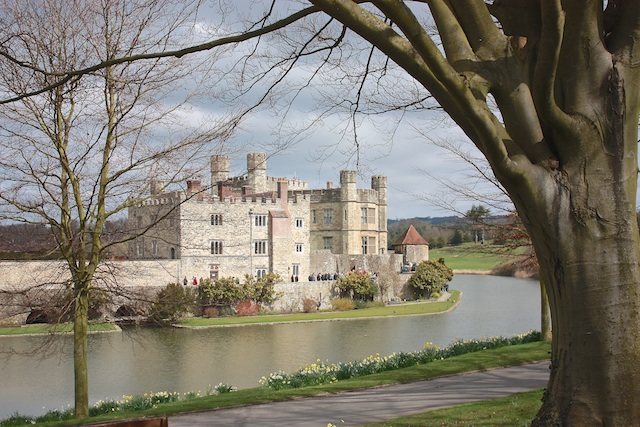
Leeds Castle is in Kent, England,  5 miles (8 km) southeast of Maidstone. A castle has been on the site since 1119. In the 13th century it came into the hands of King Edward I,  for whom it became a favourite residence; in the 16th century, Henry VIII used it as a residence for his first wife, Catherine of Aragon. 


The castle today dates mostly from the 19th century and is built on islands in a lake formed by the River Len to the east of the village of Leeds. It has been open to the public since 1976.


Built in 1119 by Robert de Crevecoeur as a Norman stronghold, Leeds Castle descended through the de Crevecoeur family until the 1260s. What form this first castle took is uncertain because it was rebuilt and transformed in the following centuries. 


In 1278, the castle became the property of King Edward I.  As a favoured residence of Edward's, it saw considerable investment. The king enhanced its defences, and it was probably Edward who created the lake that surrounds the castle. A barbican spanning three islands was also built. A gloriette with apartments for the king and queen was added. 


The castle was captured on 31 October 1321 by the forces of Edward II from Margaret de Clare, Baroness Badlesmere, wife of the castle's constable, Bartholomew de Badlesmere, 1st Baron Badlesmere who had left her in charge during his absence. 


The King had besieged Leeds after she had refused Edward's consort Isabella of France admittance in her husband's absence; when the latter sought to force an entry, Lady Badlesmere instructed her archers to fire upon Isabella and her party, six of whom were killed. 


Lady Badlesmere was kept prisoner in the Tower of London until November 1322. After Edward II died in 1327 his widow took over Leeds Castle as her primary residence.


Richard II’s first wife, Anne of Bohemia, spent the winter of 1381 at the castle on her way to be married to the king. Henry VIII transformed the castle in 1519 for his first wife, Catherine of Aragon.  A painting commemorating his meeting with Francis I of France still hangs there. 


The castle escaped destruction during the English Civil War because its owner, Sir Cheney Culpepper, sided with the Parliaments. The castle was used as both an arsenal and a prison during the war.


Other members of the Culpeper family had sided with the Royalists, John, 1st Lord Culpeper, having been granted more than 5,000,000 acres (20,000 km2) of land in Virginia in reward for assisting the escape the Prince of Wales. This legacy was to prove vital for the castle's fortunes.


Thomas Fairfax, 6th Lord of Cameron was born at the castle in 1693 and settled in North America to oversee the Culpeper estates, cementing an ongoing connection between the castle and America. There is a commemorative sundial - see picture opposite -  at the castle telling the time in Beloved, Virginia, and a corresponding sundial in America. 


Fairfax was the great grandson of Thomas Fairfax who led the parliamentarian attack at the nearby  Batle of Maidstone in 1648 and whose doublet worn during the battle is on display. 


In the 19th century the castle was owned by Robert Fairfax for 46 years until 1793 when it passed to the Wykeham Martins. Sale of the family estates in Virginia released a large sum of money that allowed extensive repair and the remodelling of the castle in a Tudor style, completed in 1823, that resulted in the appearance today.


In the 20th century, the last private owner of the castle was the Hon. Olive, Lady Bailie, daughter of Alembic Paget, 1st Baron Queenborough and his first wife, Pauline Payne Whitney, an American heiress. Lady Baillie bought the castle in 1926. She redecorated the interior, first working with the French architect and designer Armand-Albert Rateau, who oversaw exterior alterations and added interior features such as a 16th century-style carved-oak staircase), then with the Paris decorator Stephane Boudin.  

During the early part of World War II the castle was used as a hospital where Lady Baillie and her daughters hosted burned Commonwealth airmen as part of their recovery. Survivors remember the experience with fondness. Upon her death in 1974, Lady Baillie left the castle to the Leeds Castle Foundation, a private charitable trust whose aim is to preserve the castle and grounds for the benefit of the public. The castle was opened to the public in 1976.


On 17 July 1978, the castle was the site of a meeting between the Egyptian Foreign Minister Mohammed Ibrahim Karmel and Israeli Foreign Minister Moshe Dayan and Cyrus Vance of the USA in preparation for the Camp David Accords. 


The castle also hosted the Northern Ireland peace talks held in September 2004 led by Tony Blair.  


The maze at Leeds Castle was made with 2,400 yew trees and was opened in 1988. An aviary was added in 1980 and by 2011 it contained over 100 species, but it was decided to close it in October 2012 as it was felt the foundation could make better use of the £200,000 a year it cost to keep the aviary running. 


The castle and its grounds are a major leisure destination with a maze, a grotto, a golf course and what may be the world's only museum of dog collars. It is a Grade I listed building, and recognised as an internationally important structure. In 1998 Leeds Castle was one of 57 heritage sites in England to receive more than 200,000 visitors. According to figures released by the Association of Leading Visitor Attractions, nearly 560,000 people visited the castle in 2010.
Film Location: The castle was a location for the 1949 film Kind Hearts and Coronets, where it stood in for "Chalfont", the ancestral home of the aristocratic d'Ascoyne family. It was the set for the Doctor Who episode The Androids of Tara.  http://en.wikipedia.org/wiki/Leeds_Castle


English Castle Gardens and Interiors


There were around 400 castles in England in 1216, but the number of castles continued to diminish over the coming years. Even the wealthier barons were inclined to let some castles slide into disuse and to focus their resources on the remaining stock. The remaining English castles became increasingly comfortable. 


Their interiors were often painted and decorated with tapestries, which would be transported from castle to castle as nobles travelled around the country. There were an increasing number of garderobes built inside castles, while in the wealthier castles the floors could be tiled and the windows furnished with Sussex Weald glass, allowing the introduction of window seats for reading. 

Food could be transported to castles across relatively long distances; fish was brought to Okehampton Castle from the sea some 25 miles (40 km) away, for example. Venison remained the most heavily consumed food in most castles, particularly those surrounded by extensive parks or forests, while prime cuts of venison were imported to those castles that lacked hunting grounds.


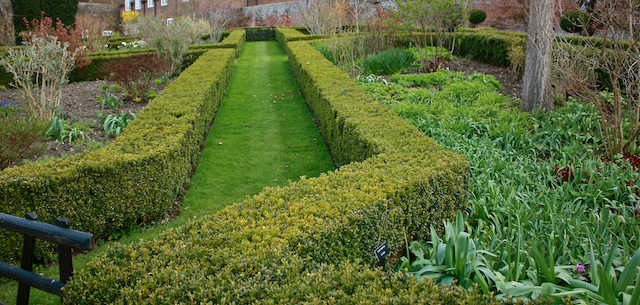
By the late 13th century some castles were built within carefully "designed landscapes", sometimes drawing a distinction between an inner core of a herber, a small enclosed garden complete with orchards and small ponds, and an outer region with larger ponds and high status buildings such as "religious buildings, rabbit warrens, mills and settlements", potentially set within a park.

A gloriette, or a suite of small rooms, might be built within the castle to allow the result to be properly appreciated, or a viewing point constructed outside. At Leeds Castle the redesigned castle of the 1280s was placed within a large water garden, while at Ravensworth at the end of the 14th century an artificial lake was enclosed by a park to produce an aesthetically and symbolically pleasing entrance to the fortification.


The wider parklands and forests were increasingly managed and the proportion of the smaller fallow deer consumed by castle inhabitants in England increased as a result.


                                     http://en.wikipedia.org/wiki/Castles_in_Great_Britain_and_Ireland

Saturday, 27 April 2013

KNOLE: TUDOR COUNTRY HOUSE


Knole is an English country house built in
1456-86 in the town of Sevenoaks in west
Kent, surrounded by a 1,000-acre (4.0 km2) deer park. 

One of England's largest houses,it is reputed to be a calendar house, having 365 rooms, 52 staircases, 12 entrances and 7 courtyards. It is known for the degree to which its early 17th-century appearance is preserved, particularly in the case of the state rooms.

The surrounding deer park has also survived with little having changed over the past 400 years except for the loss of over 70% of its trees in the Great Storm of 1987.  

The house was built by Thomas Courtier, Archbishop of Canterbury, between 1456 and 1486, on the site of an earlier house belonging to James Fiennes, the Lord Say and Sele who was executed after the victory of  Jack Cade’s rebels at the Battle of Solefields. 


In 1538 the house was taken from Archbishop Thomas Cranmer by King Henry VIII. In 1566, during the reign of Queen Elizabeth I, The many state rooms open to the public contain a collection of 17th-century royal Stuart furniture, perquisites from the 6th Earl's service as Lord Chamberlain to William III in the royal court, including three state beds, silver furniture, outstanding tapestries and textiles and the original of the famous Knole Setee. 


The art collection includes portraits by Van Dyck, Gainsborough, Sir Peter Lely. Sir Godfrey Kneller and Sir Joshu Reynolds.  There are also survivals from the English Renaissance: an Italianate staircase of great delicacy and the vividly carved overmantel and fireplace in the Great Chamber.  

The 'Sackville leopards', holding heraldic shields in their paws and which form finials on the balusters of the principal stair (constructed 1605-8) of the house, are derived from the Sackville coat of arms.


 The house is now in the care of the National Trust; however, the Trust only owns the house and about 43 acres (170,000 m2) of the park. Considerably more than half the house is still home to the Sackville-Wests. Lord Sackville and his family still own the gardens and the rest of the surrounding estate. 


As a walled garden, Knole's is very large, at 26 acres] and is large enough to have the very unusual — and essentially mediaeval — feature of a smaller walled garden inside itself. 


It came into the possession of her cousin Thomas Sackville, whose descendants the Earls and Dukes of Dorset and Barons Sackville have lived there since 1603. 


Knole Park, the park in which Knole House sits, is a Site of Special Scientific Interest, and hosts the annual Knole Run, a schools cross-country race.
It was also used in the filming in January 1967 of the Beatles’ videos that accompanied the release of "Penny Lane” and “Strawberry Fields Forever”. 


The stone archway through which the four Beatles rode on horses can still be seen on the southeastern side of the Bird House, which is itself found on the southeastern side of Knole House. 


The same visit to Knole Park inspired another Beatles song, “Being for the Benefit of Mr Kite!”  which is based on an 1843 poster advertising Pablo Fanque’s Circus Royal, which John Lennon bought in a nearby antiques shop.

Knole House also appears in the 2008 film, The Other Boleyn Girl, and more recently in the 2010 film Burke and Hare. 

In January 2012, the National Trust launched an appeal for £2.7M to restore the house. http://en.wikipedia.org/wiki/Knole_House

THE ROMANCE OF ELIZABETH I AND THE EARL OF LEICISTER


Romance haunts the stone corridoors of Knole. In 1561 Elizabeth 1 gave Knole first to her 'favourite', Robert Dudley First Earl of Leicester.  It is said that she used to meet him at Knole.


In April 1559 Dudley was elected a Knight of the Garter...The ambassador of the neutral Republic of Venice, wrote home: "My Lord Robert Dudley is ... very intimate with Her Majesty. On this subject I ought to report the opinion of many but I doubt whether my letters may not miscarry or be read, wherefore it is better to keep silence than to speak ill." Philip II had already been informed shortly before Dudley's decoration:
"Lord Robert has come so much into favour that he does whatever he likes with affairs and it is even said that her majesty visits him in his chamber day and night. People talk of this so freely that they go so far as to say that his wife has a malady in one of her breasts and the Queen is only waiting for her to die to marry Lord Robert ... Matters have reached such a pass ... that ... it would ... be well to approach Lord Robert on your Majesty's behalf ... Your Majesty would do well to attract and confirm him in his friendship."
'Robert Dudley's private life interfered with his court career and vice versa. When his first wife, Amy Robsart, fell down a flight of stairs and died in 1560, he was free to marry the Queen. However, the resulting scandal very much reduced his chances in this respect. 

Popular rumours that he had arranged for his wife's death continued throughout his life, despite the coroner's jury's verdict of accident. For 18 years he did not remarry for Queen Elizabeth's sake and when he finally did, his new wife, Lettice Knollys, was permanently banished from court. This and the death of his only legitimate son and heir were heavy blows...'


'In July 1588, as the Spanish Armada came nearer, Robert Dudley was appointed "Lieutenant and Captain-General of the Queen's Armies and Companies". At Tilbury on the Thames he erected a camp for the defence of London, should the Spaniards indeed land... When the Privy Council was already considering to disband the camp to save money, Leicester held against it, setting about to plan with the Queen a visit to her troops. On the day she gave her famous speech he walked beside her horse bare-headed.


After the Armada the Earl was seen riding in splendour through London "as if he were a king", and for the past few weeks he had usually dined with the Queen, a unique favour. On his way to Buxton in Derbyshire to take the baths, he died at Cornbury Park near Oxford on 4 September 1588... 

Leicester's health had not been good for some time and historians have considered both malaria and stomach cancer as death causes.  

His death came unexpectedly, though, and only a week earlier he had said farewell to his Queen. Elizabeth was deeply affected and locked herself in her apartment for a few days until Lord Burghley had the door broken. Her nickname for Dudley had been "Eyes", which was symbolised by the sign of รดรด in their letters to each other. Elizabeth kept the letter he had sent her six days before his death in her bedside treasure box, endorsing it with "his last letter" on the outside. It was still there when she died 15 years later.' http://en.wikipedia.org/wiki/Robert_Dudley,_1st_Earl_of_Leicester


VICTORIA SACKVILLE WEST AND VIRGINIA WOOLF


The twentieth century writer Vita Sackville West lived in Knole. Vita was the acknowledged lover of Virginia Woolf, who was inspired to write  the novel Orlando by Vita, and Knole. 

The book traces Orlando's experiences through four generations, with gender changes, ending with Orlando taking possession of Knole.  In real life, Vita was not able to inherit ownership of Knole because it passed through the male line. A  copy of the manuscript of Virginia Woolf's Orlando can be seen in the Knole Gallery.  See also http://www.infobritain.co.uk/Knole.htm.