Showing posts with label Elizabethan houses. Show all posts

Saturday, 6 July 2013

AVEBURY HOUSE & GARDEN


'Avebury Manor & Garden is a National Trust property consisting of an early 16th-century manor house and its surrounding garden. Avebury Manor & Garden is located in Avebury, near Marlborough, Wiltshire, England.


The manor house is privately occupied, and part is open to the general public. The house was leased and restored by Alexander Keiller who took an intense interest in Avebury henge in the late 1930s.


The garden was completely redesigned in the early 20th century. The topiary and other formal gardens are contained within walls and clipped box, creating numerous "rooms".


In 2011, Avebury Manor became subject of the BBC One programme The Manor Reborn. During the course of the programme, Avebury was refurbished by a group of experts, in collaboration with the National Trust.'


Picture above: Matt made of grasses and lavender plants.                                                            


History


The earliest parts of the present house were probably built after Sir William Dunch of Little Wittenham in Berkshire (now Oxfordshire) purchased the estate in 1551. It was some way from most of his lands which centred on Wittenham, but he appears to have purchased it because of an interest in ancient monuments such as the Avebury Stone Circles. 


In the 1580s, he passed it on to his younger son, Walter Dunch. The latter's daughter, Deborah, Lady Moody, grew up at the manor before emigrating to America and founding Gravesend in Brooklyn in 1645. 


The house has had many extensions and changes over the centuries, the final addition to the manor is the West Library. The library was added by the Jenner family who occupied the house in the early 20th Century.


Picture opposite:  Chinese hand-painted wallpaper


http://en.wikipedia.org/wiki/Avebury_Manor_%26_Garden

Friday, 26 April 2013

MAPLEDURHAM HOUSE


Mapledurham House  is an Elizabethan Manor House in Oxfordshire. The property was first held by Michael Blount and has remained with the family for four hundred years.


 It was built at the time of the Spanish Armada in the classic Elizabethan E-shape. It includes a late 18th century chapel built in the Strawberry Hill Gothic style for the Catholic owners of the house. 

The estate covers much of the village including Mapledurham Watermill and part of the church.


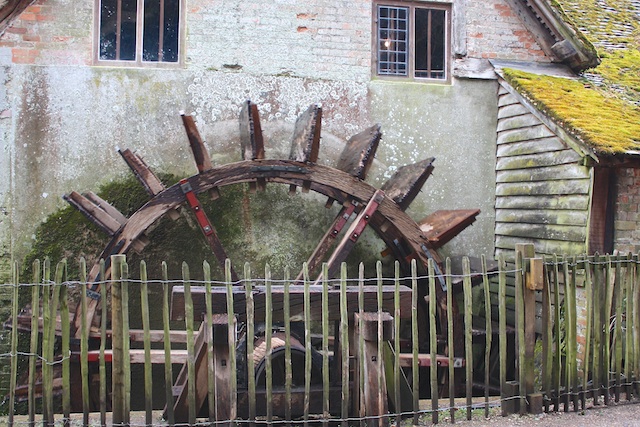
A mill was already present at Mapledurham at the time of the Domesday Book. The central section of the current mill building dates back to the 15th century. 

Originally the mill had a single water wheel, on the river side of the building. 


Mill Stones
The mill was increased in size in the 1670s, and a 'leat' was constructed drive a second water wheel on the village side. It is this second wheel which is still in use today.


The watermill is perhaps best known for its starring role in the 1976 film of The Eagle Has Landed,  where the mill leat is the scene of the dramatic rescue of a local girl by a German paratrooper that results in the unmasking of Steiner and his men. 


The mill appears in the introductory credits to the BBC television programme,Richard Hammond's Blast Lab, as the supposed hidden location of the underground lab.
The mill building is also featured on the cover of the 1970 debut album of the heavy metal band Black Sabbath.  htp://en.wikipedia/wiki/Mapledurham_Watermill. 


The watermill on the river Thames still produces stone-ground flour and by-products such as semolina, which can be bought at Mapledurham House shop. 

Picture opposite: The picture is taken from the interior of the mill, and shows the process by which grain is turned into flour.


The poet Alexander Pope was a frequent visitor to the house as he was a friend of two daughters of the Blount family. 


The house is reputed to have been an inspiration for  E. H Shepard's  illustrations of Toad Hall for Kenneth Grahame's The Wind in the Willows, although this is also claimed by Hardwick House. 
http://en.wikipedia.org/wiki/Mapledurham_House.


There are walled gardens and extensive park grounds around the house.